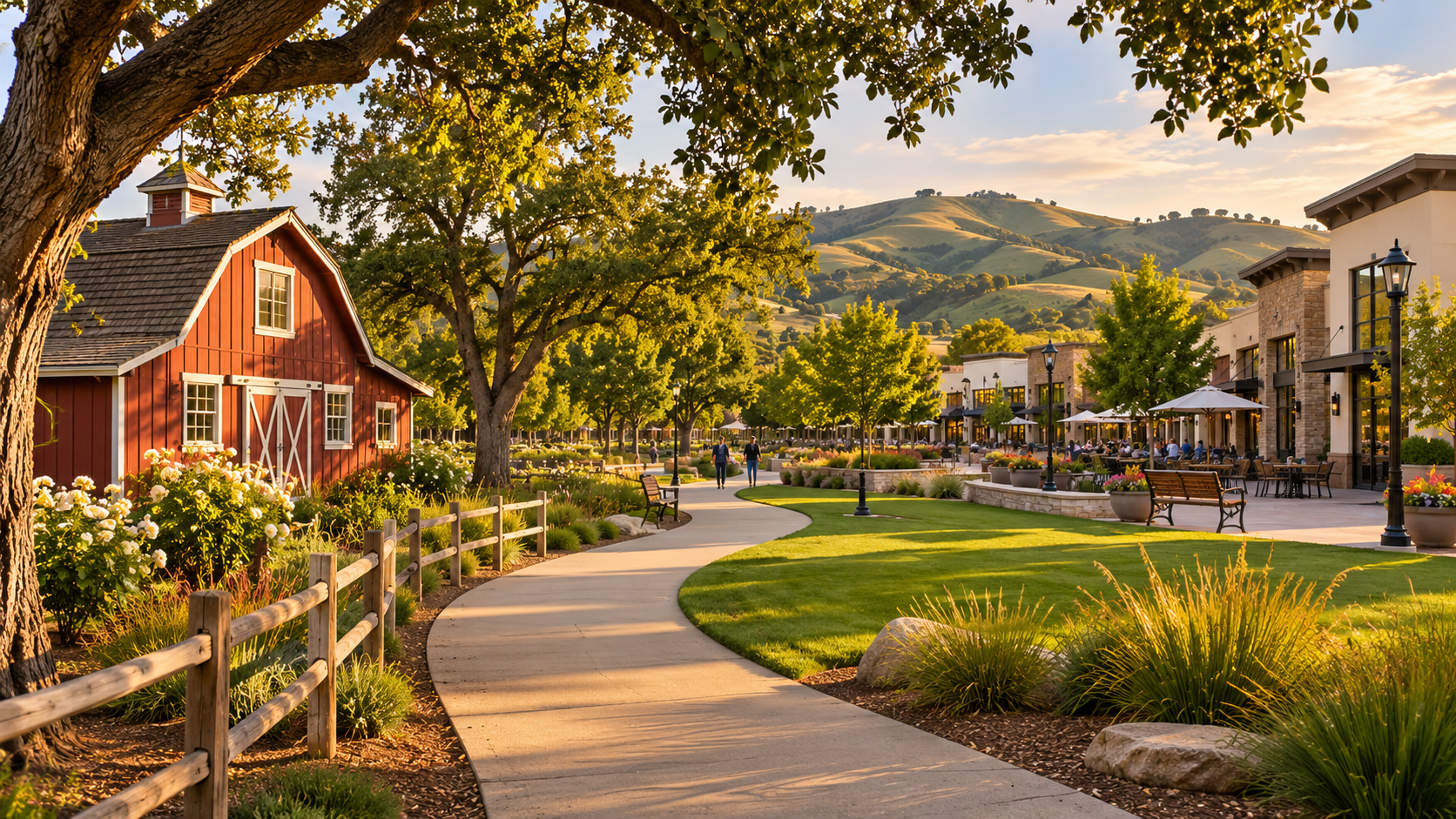
From preserved agricultural history and broad parks to contemporary architecture, dining and the trails connecting it all.
Yasmine Austere | REALTOR® & Relocation Specialist
Explore San Ramon through a mix of preserved history, modern gathering places, parks, trails and open space.
San Ramon is often described as one of the East Bay’s newer, more contemporary communities. That is true but only partly true.
Look closely and two versions of the valley appear at once.
One is modern: offices, architecture, restaurants, parks, carefully planned neighborhoods and a city center designed for the way people live now.
The other is older: former ranch land, agricultural buildings, tree-lined roads and open hills that existed long before San Ramon incorporated as a city.
The pleasure of exploring San Ramon comes from moving between the two.
Start With the Valley Before the City
Forest Home Farms Historic Park is one of the best places to understand what came before today’s San Ramon. The preserved property tells the agricultural story of the San Ramon Valley through historic structures, farm grounds, exhibits and a tractor museum.
The 16-acre Boone family farm was given to the City of San Ramon so the property could remain a public historic park rather than disappear into development. That decision feels increasingly significant when standing there today. Around the farm, a modern city has grown. Inside its boundaries, the valley’s agricultural past remains visible and tangible.
Walk the grounds slowly. The appeal is not spectacle. It is context.
San Ramon makes more sense after seeing what the land once was.
Then See What the Valley Became
A short distance away, City Center Bishop Ranch tells almost the opposite story.
Designed by the Renzo Piano Building Workshop in collaboration with BAR Architects, City Center was conceived as a contemporary public gathering place rather than a conventional enclosed mall. Restaurants, shops, wellness, entertainment and open-air spaces surround a central plaza that regularly functions as a community room without walls.
This is San Ramon’s newer identity at its most visible. People meet for coffee, stay for lunch, see a movie, shop or simply sit outside while children move around the plaza. The architecture is clean and modern, but the purpose is surprisingly traditional: give people a place to gather.
For visitors, City Center works well as an afternoon or evening stop. For residents, its importance is more practical. It gives a city that grew largely through planned neighborhoods and business development a recognizable center of gravity.
Follow the Trail Through the City
One of the easiest ways to understand San Ramon geographically is to spend time on the Iron Horse Regional Trail. The nearly 30-mile regional route runs through the city and connects communities from Pleasanton north toward Concord.
Locally, the trail is much more than a recreational amenity. It links neighborhoods, parks, employment areas and commercial destinations. Cyclists use it. Runners use it. Families use it. People heading to City Center can even arrive by bicycle.
That everyday usefulness is part of what makes the trail important. San Ramon may be suburban in form, but there are places where it is possible to move between parts of the city without relying entirely on a car.
Make Time for the Parks
San Ramon’s park system is one of the features residents tend to appreciate more after living here than before moving in. Central Park, near City Hall and the library, provides a broad community gathering space, while smaller neighborhood parks are woven through residential areas.
These spaces are where a planned city becomes personal. Youth sports, evening walks, community events, playground visits and weekend routines gradually turn public infrastructure into memory.
For more rugged terrain, the western edge of San Ramon meets Las Trampas Wilderness Regional Preserve. The preserve offers thousands of acres of steep ridges, winding trails, geological formations and views stretching across multiple East Bay valleys. The contrast is remarkable: contemporary San Ramon sits only minutes from terrain that can feel genuinely wild.
Spend an Evening in the New Center
After a day moving between farm history, trails and parks, City Center is an easy place to finish.
Dinner can stretch into a walk around the plaza or a movie at THE LOT. On event days, the space becomes even more animated.
There is something fitting about ending here after beginning at Forest Home Farms.
The two locations are separated by only a short drive, yet they tell nearly the entire story of San Ramon: land once used for agriculture, decades of Bay Area growth, the development of Bishop Ranch, expanding neighborhoods and a city continuing to create a stronger civic center.
What Exploring San Ramon Reveals About Living Here
San Ramon is not trying to be Danville, and it is not Alamo. Its personality is more contemporary, more planned and in many areas more visibly connected to the Bay Area economy.
That difference is worth understanding because buyers often begin their search by grouping Danville, Alamo and San Ramon together. Geographically, that makes sense. Experientially, they can feel very different.
San Ramon appeals to people who appreciate parks, trails, newer neighborhoods, community facilities, access to employment and a growing collection of places to gather. At the same time, its preserved farm and surrounding hills keep the city connected to the older San Ramon Valley story.
The best way to appreciate San Ramon is to experience both sides in the same day.
Begin with what the valley was. Walk through what it has become. Then look toward the hills and remember that both stories are still present.