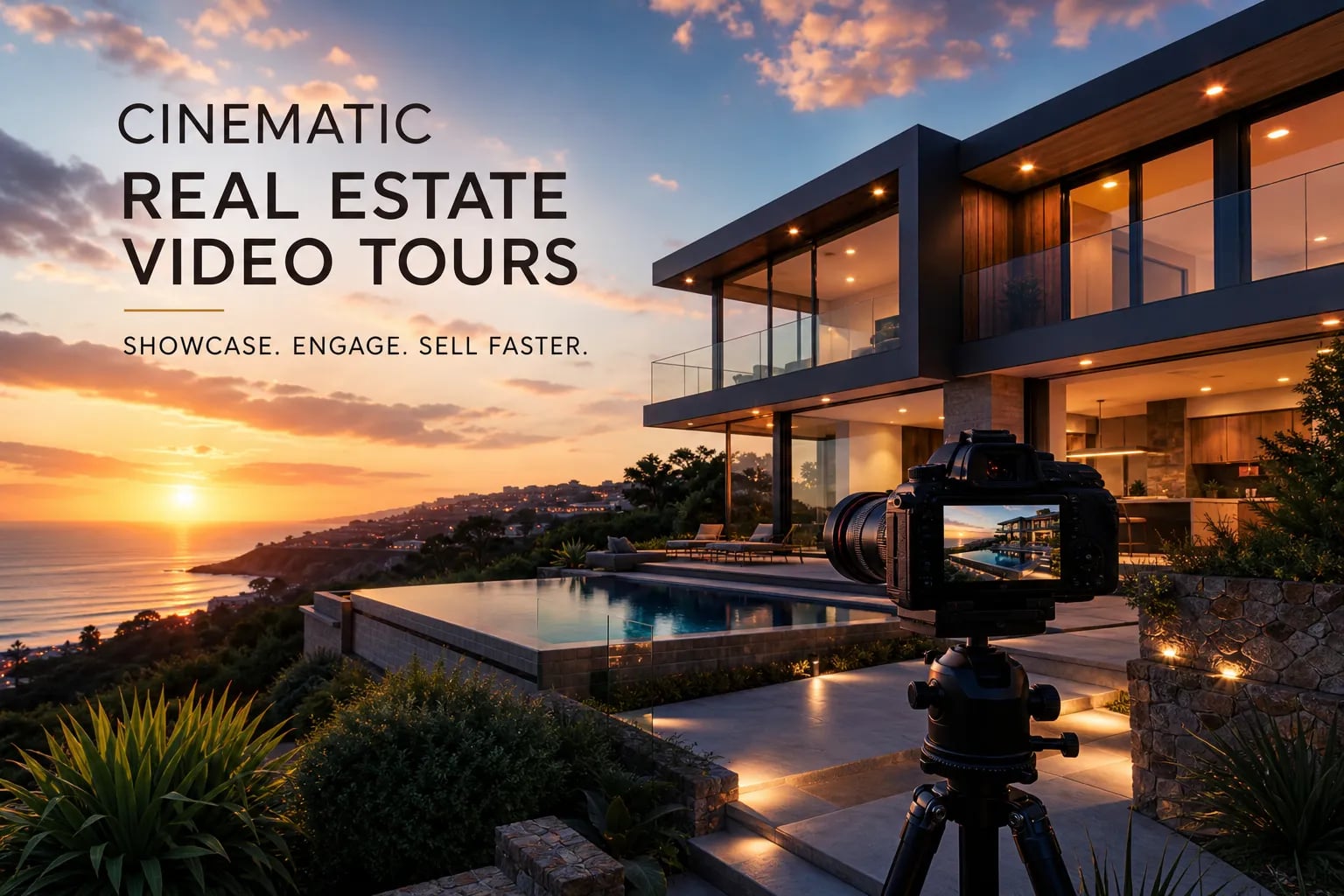
Cinematic real estate video tours are professionally produced property films that use camera movement, color grading, drone footage, and deliberate pacing to tell a visual story, not just document a floor plan. They sell homes faster because they attract buyers who are emotionally invested before they ever schedule a showing. A listing with a cinematic property tour reaches a buyer who has already pictured themselves in the kitchen, on the back patio, and in the master suite. That buyer shows up ready to make decisions.
This article breaks down what separates a true cinematic listing video from a basic walkthrough, how it compares to 3D virtual tours and photo slideshows, what professional real estate video production costs in 2026, and whether to hire a pro or use an AI tool. You’ll also see what luxury marketing looks like in practice, using East Bay listings as the real-world benchmark.
Key Takeaways
- Cinematic video drives early interest: Buyers who watch a well-produced cinematic property tour arrive emotionally invested, not just curious.
- Production costs are accessible: A polished cinematic listing video runs $500, $1,200 for most homes, less than 0.1% of a $1M+ sale price.
- Timeline is manageable: Plan for 5, 7 business days from shoot to final delivery for a standard cinematic package.
- AI tools have a real role: Photo-to-video platforms work well for standard-priced listings and social content; professional crews remain the right call above $1M.
- No single format does everything: Video brings buyers in, Matterport helps them qualify, and photos provide the reference layer.
- First 7, 10 days are critical: A cinematic video that goes live with the MLS listing, not after it, creates qualified interest before the first open house.
What Separates a Cinematic Listing Video from a Basic Walkthrough?
Most sellers have seen shaky phone videos passed off as property tours. A true cinematic real estate video tour is something categorically different, built on production decisions that are visible in every frame. The core technical elements include:
- A stabilized camera on a 3-axis gimbal
- 4K resolution filmed at 24fps with a 1/50-second shutter speed to preserve natural motion blur
- An aperture around f/4, f/5.6 to keep rooms sharp without flattening depth
- Manual white balance set once per lighting environment
- A flat or log color profile captured specifically for post-production grading
That combination produces footage quality no handheld phone can replicate, regardless of megapixel count.
The shot progression matters just as much as the settings. A cinematic tour opens with a wide exterior establishing shot, moves room by room using leading lines, doorways, hallways, countertops, to guide the viewer, then closes with detail shots of finishes and fixtures before returning to an exterior lifestyle close. Each move is slow and deliberate. Each transition gives the viewer a moment to absorb the space rather than rushing past it.
Technical quality is only half the equation. A cinematic video tour has narrative structure: an establishing exterior, a room-by-room progression, and a detail-driven close. Licensed music sets emotional tone without overpowering the visuals. Camera movement is intentional and slow, guiding the eye the way a host would guide a guest through their home. That combination turns a property tour into something closer to a short film about a lifestyle, and that distinction separates qualified emotional interest from passive browsing.
Why Cinematic Real Estate Video Tours Bring In More Qualified Buyers
A buyer who watches a well-paced cinematic video tour engages with the property differently than one who clicks through photos. The lighting choices, deliberate pacing, and fluid camera movement create a feeling about the home, not just an impression of square footage. That emotional connection is what pushes a buyer to request disclosures or book a showing before the weekend open house, turning passive scrollers into motivated prospects.
This effect is most pronounced for move-up buyers and luxury buyers, because they’re not purchasing a house. They’re buying a version of their next life. A cinematic listing video delivers that vision in a way that a photo grid simply cannot. For properties in the $1.5M, $4M+ range in the East Bay, buyers are often comparing several well-staged, professionally photographed homes. A cinematic tour keeps one listing in a buyer’s mind longer than the others, and it performs well on social platforms where shares and organic reach extend well beyond the MLS.
How Cinematic Real Estate Video Tours Compare to 3D Walkthroughs and Photo Slideshows
Each format serves a different moment in the buyer’s decision journey. The table below shows how they stack up across the criteria that matter most for a premium listing.
| Format | Initial engagement | Emotional impact | Spatial understanding | Best-fit use case |
|---|---|---|---|---|
| Cinematic video | High; autoplay-friendly across social and listing sites | Strongest; pacing, movement, and music create desire | Moderate; guided but linear | Attracting attention and generating showing requests |
| Matterport 3D virtual home tour | Highest dwell time; buyers self-navigate | Moderate; immersive but information-driven | Best; buyers inspect floor plan and room relationships at their own pace | Remote buyers, relocating professionals, complex floor plans |
| Photo slideshow | Fast to scan, low depth | Low; fixed angles, no movement or audio | Limited; selected views only | MLS baseline and rapid comparison browsing |
The right answer is rarely choosing just one format. Video brings buyers in, a Matterport virtual home tour helps them qualify themselves and verify the layout before booking a flight, and photos provide the essential reference layer for portal searches. For a straightforward listing, professional photos plus a concise cinematic video often deliver the right return on investment. For a luxury or move-up property, all three formats working together is the most defensible marketing position. Removing any one of them creates a gap in the buyer’s decision process.
What Does Professional Real Estate Video Production Actually Cost?
In 2026, listing video production breaks into three clear tiers:
- Basic ($200, $500): A 60, 90-second single-camera walkthrough with light editing and standard music.
- Cinematic ($500, $1,200): Multi-room sequencing, color grading, licensed audio, smooth transitions, and often limited drone footage.
- Premium ($1,000, $2,000+): Full drone aerials, luxury-style cinematography, professional voiceover or agent introduction, motion graphics, and multiple platform-ready cuts in both horizontal and vertical formats.
- Luxury custom ($3,000, $5,000+): Lifestyle scenes, extensive aerial work, and bespoke deliverables for high-end properties.
- Drone-only add-on ($150, $500): Available when not bundled into a package.
Production Timeline: What to Expect
The production timeline follows predictable stages once you know the sequence. Pre-production takes 1, 3 days and covers shot list preparation, staging coordination, and drone permit filing where required. On-site shooting runs 2, 4 hours for most residential properties. Editing follows, taking 1, 5 business days depending on complexity.
After editing, budget 1, 3 business days for client review and revisions, then final delivery in multiple platform formats. As a practical benchmark: a basic tour is typically ready in 24, 72 hours, a standard cinematic listing video in 5, 7 business days, and a luxury multi-deliverable production in 7, 14 business days. Schedule filming 3, 7 days before your listing goes live to absorb weather delays, staging changes, and format-specific export requirements.
Should You Hire a Pro or Use an AI Photo-to-Video Tool?
AI photo-to-video platforms have matured into legitimate options for the right listing tier. Tools in this category can generate polished listing reels from existing photos in minutes. They work well for standard-priced listings where video budget is limited, for quick social media content when a full production isn’t feasible, and for agents managing multiple listing reels per month at scale. The strongest platforms in this space produce convincing results with realistic camera motion and music-led room-to-room sequencing rather than simple photo zooms.
For listings above $1M, architecturally distinctive properties, homes with exceptional outdoor spaces, or any property where the lifestyle narrative matters as much as the floor plan, a professional crew is the right call. Real camera movement, actual lighting control, and genuine drone footage create an emotional register that AI animation on still photos cannot replicate. Buyers consistently respond more strongly to professionally filmed cinematic real estate video tours, even when they can’t pinpoint exactly why one video feels more compelling than another. The ROI case is direct: a $600, $1,200 cinematic video on a $2M+ listing represents less than 0.1% of the sale price, and it can be the single reason one buyer chooses your listing over a comparable property with photos only.
How Yasmine Austere Markets East Bay Homes with Cinematic Video
Yasmine Austere‘s listings across Danville, Alamo, San Ramon, and Walnut Creek use a full-stack marketing approach from day one: professional cinematic video tours, licensed drone photography, and Matterport 3D virtual walkthroughs layered together and deployed simultaneously at launch. The cinematic video runs on YouTube, Instagram, and targeted digital campaigns to reach buyers well beyond what the MLS alone can deliver. The 3D walkthrough stays embedded on the listing page for serious buyers, particularly corporate relocatees and out-of-state buyers who need to verify layout before booking a flight. Professional photos anchor the search portal presence. No single format carries the full marketing load, because no single format should.
In the East Bay’s competitive market, the first 7, 10 days of a listing’s life determine its trajectory. A cinematic video tour that goes live at the same time as the MLS listing, rather than a week later, means qualified buyers arrive emotionally invested before the first open house. Yasmine’s 26+ years of experience and $250M+ in closed sales are backed by a marketing strategy that most local agents don’t match. For luxury sellers and move-up buyers who want their home seen as more than a line item on a portal, this is the approach that delivers results.
The Bottom Line on Cinematic Real Estate Video Tours
Cinematic real estate video tours are no longer a luxury marketing add-on. For move-up buyers, luxury sellers, and corporate relocatees evaluating East Bay properties from out of state, they’re the difference between a listing that gets watched and a listing that gets visited. Production costs are accessible at $500, $1,200 for most listings, timelines are manageable at 5, 7 business days for a polished cut, and buyer response is measurable in showing requests and qualified inquiries. Whether you use a professional crew or an AI tool depends on your listing tier and budget, but skipping video entirely is the one decision that consistently costs sellers the most.
If you’re preparing to sell in Danville, Alamo, Walnut Creek, or anywhere in the East Bay, the quality of your marketing is not a line item to trim. Reach out to Yasmine Austere to see what luxury-caliber cinematic listing video marketing looks like in practice, while your listing timeline still allows it.
Frequently Asked Questions
How far in advance should I schedule filming before my listing goes live?
I recommend scheduling filming 3 to 7 days before your listing goes live. That timing absorbs weather delays, staging changes, and format-specific export requirements while matching the typical pre-production and editing windows.
Which types of listings benefit most from cinematic real estate video tours?
Cinematic video tours benefit move-up buyers, luxury sellers, and corporate relocatees most of all. They perform especially well for East Bay properties in the $1.5M to $4M+ range and help buyers picture the lifestyle rather than just the floor plan.
Can AI photo-to-video tools replace professional drone footage and real camera movement?
No — AI photo-to-video tools work well for standard-priced listings and social content but do not replicate genuine drone footage or real camera movement. For listings above $1M, architecturally distinctive properties, or homes where lifestyle narrative matters, a professional crew remains the right call.
How quickly do cinematic videos affect buyer behavior after a listing goes live?
Cinematic videos create qualified interest early, often before the first open house within the first 7 to 10 days of a listing’s life. Buyers who watch a well-paced cinematic tour frequently arrive emotionally invested and may request disclosures or book showings sooner than those who only see photos.