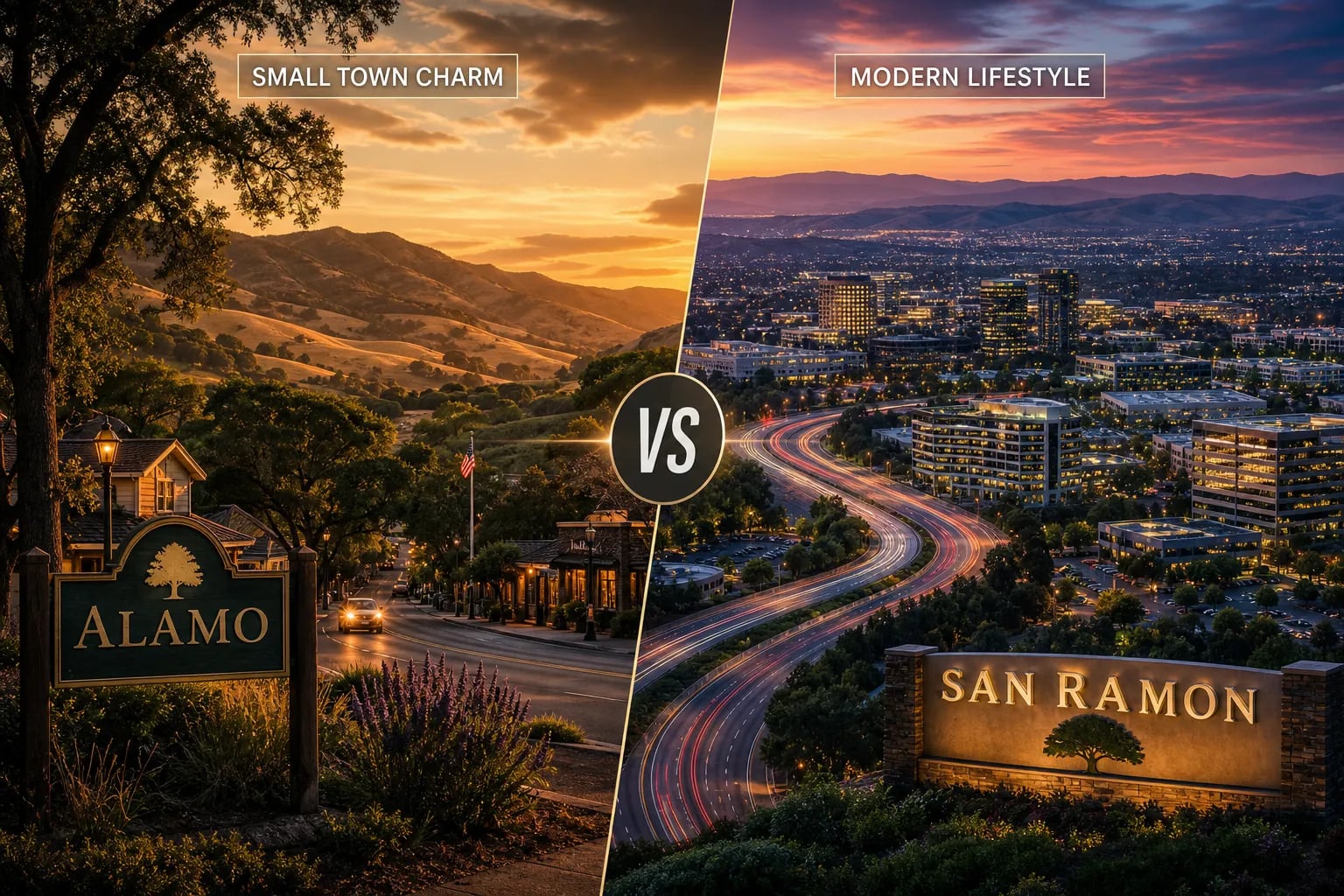
When comparing Alamo vs San Ramon CA, the two cities look almost identical on paper but feel completely different in person. Pull up a map of the East Bay and you’ll see they share a border, and they also share an interstate, a school district, and a zip code prefix. At street level, though, the gap between how similar they look and how different they actually live is exactly where buyers get stuck.
Yasmine Austere, a top 2% Realtor and East Bay relocations specialist with over 26 years working these two communities, has guided hundreds of buyers through this exact comparison. The question is almost never “which city is better?” It is “which city is better for you?” This breakdown gives you the concrete data to answer that.
Alamo vs San Ramon CA: Price points and what your budget actually buys
Alamo sits firmly in luxury territory, and the numbers make that clear. The 2026 median sale price hovers between $2.3M and $2.9M depending on the source and month, Redfin reported $2,823,513 for the three months ending June 2026, while Realtor.com tracks closer to $2,297,000. The dominant home style is the classic California ranch, set on generous lots with mature oak trees, wide frontages, and in many cases equestrian facilities. Entry-level listings in the Alamo housing market are genuinely rare. Buyers come here expecting space, architectural character, and privacy as baseline requirements, and few listings fall below that threshold.
San Ramon opens the door at a meaningfully lower price point, which explains a significant portion of its appeal. The San Ramon cost of living, particularly on the housing side, reflects a 2026 median around $1.3M to $1.6M depending on the source, Redfin shows $1,574,643 for June 2026 and Realtor.com tracks closer to $1,298,500. The inventory mix is considerably broader: newer planned communities, townhomes, and single-family homes across multiple price tiers, from more accessible suburban options near the eastern neighborhoods up to executive-level homes in Gale Ranch and Windemere. For buyers who want proximity to top-rated schools and major employers without Alamo’s luxury floor, San Ramon delivers real flexibility.
On market momentum, the two cities tell very different stories in 2026. Alamo prices rebounded sharply after a choppy 2025, up 12.9% year over year as of June 2026 per Redfin, with median days on market as low as 10 for well-priced homes. Competition for correctly priced properties is real. San Ramon’s market shows softer appreciation, Zillow tracked values down roughly 7.4% year over year in early 2026, and Redfin showed near-flat movement through June. San Ramon’s larger inventory and broader price tiers give buyers more liquidity, but the appreciation intensity Alamo buyers have seen recently simply isn’t there.
Schools: same district, meaningfully different access
Most buyers are surprised to learn that Alamo and San Ramon are both served by San Ramon Valley Unified School District (SRVUSD). Buyers choosing between these two cities are not choosing between school districts. They are choosing between specific campuses and the school communities surrounding them.
SRVUSD’s credentials are strong across the board. Niche rates the district A+ overall, ranking it #27 in California and #179 nationally. SchoolDigger gives it a 5-star rating, placing it in the 97th percentile of California’s 1,568 districts. Elementary students across the district outperform state averages by a wide margin: 77% proficiency in English Language Arts and 74% in Mathematics, compared to California averages of 47% in each subject. Dougherty Valley High School, one of the district’s flagship campuses in San Ramon, is ranked #22 of 2,323 California high schools on SchoolDigger with an 88% ELA proficiency rate. For buyers whose decisions hinge on academic outcomes, the data here is consistently strong regardless of which campus a child attends.
Alamo’s school footprint is smaller and tighter. The community feeds into Alamo Elementary, Rancho Romero Elementary, and Stone Valley Middle School. High school students typically attend Monte Vista High School, which earns strong marks from local parents and is commonly regarded as one of the district’s more academically rigorous campuses. With fewer school options within its borders, Alamo tends to produce tighter-knit school communities, deeper parent involvement and more consistent social continuity from elementary through middle school are patterns local families frequently cite. San Ramon offers more in-city campus options at each grade level, which suits families who want more flexibility in school selection. The tradeoff is that San Ramon’s larger suburban scale can make those school communities feel slightly more diffuse, though academic quality remains high throughout the district.
Alamo vs San Ramon CA: Community feel and lifestyle
Alamo is an unincorporated community in Contra Costa County, a distinction that shapes its character in practical ways. Without a city government or city budget driving commercial development, Alamo has maintained a semi-rural profile that residents actively protect. Large-scale retail and dense shopping centers are essentially absent; what you find instead are tree-lined roads, horse properties, hiking trails, and neighbors who chose Alamo specifically because they didn’t want suburban density nearby. The community skews toward established families and long-time East Bay residents who have made a conscious decision to trade convenience for space and quiet.
San Ramon operates as a full city with the infrastructure that comes with it. The City Center Bishop Ranch development has become a genuine downtown anchor, with restaurants, retail, a farmers market, and a walkable core that Alamo has no equivalent of. San Ramon’s parks system is well-funded, youth sports leagues are plentiful, and virtually every major service is within a short drive. For families with young children who want amenities close by, San Ramon delivers in a way Alamo simply doesn’t try to. The community skews younger on average, with a high concentration of dual-income professional households drawn by the job base and lifestyle infrastructure.
Neither community is a compromise, but they require different mindsets. Alamo buyers are choosing a lifestyle defined by space, privacy, and natural surroundings, and they are paying a premium for it. San Ramon buyers are choosing connectivity, convenience, and community energy at a price point that leaves more room in the budget for other priorities. The better question is not which lifestyle is superior, it is which one matches how your household actually wants to spend its time.
Commute and employer access: where each city positions you for work
The average one-way commute from Alamo runs approximately 35.8 minutes, while San Ramon averages 30.4 minutes. That five-minute difference understates the real commute gap for specific destinations. Alamo residents heading to San Francisco can get there in roughly an hour and four minutes using bus connections to BART; San Ramon residents face closer to 90 minutes each way by public transit through the Dublin/Pleasanton BART station. Neither city sits directly on a BART line, which is a critical reality check for buyers who depend on transit for a San Francisco-based role.
San Ramon’s defining employment advantage is Bishop Ranch, one of the largest suburban business parks in the country. The campus houses roughly 30,000 employees across 600-plus companies, including Chevron’s global headquarters, PG&E (with over 2,200 employees on site), AT&T’s West Coast headquarters, SAP, GE Digital, and JPMorgan Chase. For buyers who work at Bishop Ranch or with companies that maintain offices nearby, the commute is essentially the distance from the driveway to the campus gate, a proximity that carries real dollar value that doesn’t show up in the list price.
For Silicon Valley commuters, neither city is ideal. Both require BART transfers, and travel times to San Jose or Sunnyvale frequently stretch past 90 minutes each way by transit. Buyers with South Bay roles who want to live in either Alamo or San Ramon typically plan around driving to a BART station or accepting a longer commute as a known lifestyle tradeoff in exchange for East Bay quality of life.
Safety and long-term market stability
Both cities score well on safety, and for families relocating from outside the Bay Area, both clear the threshold without reservation. Alamo consistently earns A or A+ safety grades across third-party platforms, with very low violent crime rates and property crime levels that third-party platforms rate well below typical national benchmarks, though figures vary by source. San Ramon carries a comparable reputation: OpenCrime gives it an A+ safety grade, DoorProfit rates it A-, and the San Ramon Police Department’s own reporting shows 12.22 crimes per 1,000 residents in 2024, an overall crime rate roughly 49% below the national average. The difference between the two cities on safety is minimal and should not drive the decision in either direction.
Where the cities diverge more meaningfully is in long-term market stability and the character of their appreciation cycles. Alamo’s limited inventory and luxury-tier price floor create natural scarcity dynamics that have historically supported values over time. The 2026 rebound, with prices up 16.1% from April 2025 to April 2026 and Redfin reporting 12.9% year-over-year gains through June 2026, reflects that scarcity clearly. San Ramon’s broader price spectrum and higher inventory turnover create more liquidity, which is genuinely useful for corporate relocatees and move-up buyers who may sell again within five to seven years and need a market that can absorb the exit without requiring a perfect pricing environment.
Which city is the right fit for your family?
Two buyer profiles emerge clearly from this Alamo vs San Ramon comparison. If you want a semi-rural setting with large lots, architectural character, privacy, and a tight-knit school community, and you’re comfortable with a price floor above $2.3M, Alamo is built for exactly that buyer. If you want top-rated SRVUSD schools with more campus options, direct access to a major employment center, walkable amenities, and broader price accessibility in the $1.3M to $1.6M median range, San Ramon is the stronger fit. There is no objectively better answer. There is a right answer for your specific priorities, and those priorities rarely look identical for any two families.
The comparison on paper gets you close, but the decision usually comes down to nuances that only surface when you walk specific streets, understand how a particular home’s location interacts with your actual commute route, and feel the difference between a semi-rural Alamo CA neighborhood and a planned San Ramon community in person. Yasmine Austere has spent over 26 years working both Alamo and San Ramon with buyers at every price point and life stage, from corporate relocatees navigating tight timelines to move-up buyers juggling a simultaneous sale. Her free consultation is a direct conversation about your specific priorities, not a sales pitch, and it consistently shortens the decision timeline for buyers who have been circling this comparison for weeks.
The bottom line on Alamo vs San Ramon CA
These two East Bay communities represent two genuinely different philosophies about how to live in the same great part of California. Alamo delivers exclusivity, space, and a quiet semi-rural character that its residents protect fiercely, at a luxury price point that reflects real scarcity. San Ramon delivers employer proximity, suburban amenities, school access, and price flexibility across a much broader buyer spectrum. Both communities share California’s top-ranked school district, comparable safety grades, and the same I-680 corridor connecting the East Bay to its major job centers, but they serve different buyers with different priorities.
The bottom line in the Alamo vs San Ramon CA decision is which tradeoffs match how you want to live. Inventory in both markets is limited and correctly priced homes move fast, so preparation matters. When you’re ready to get specific about Alamo CA neighborhoods, San Ramon neighborhoods, school attendance zones, and what your budget actually buys in each city right now, Yasmine Austere knows both communities in detail and can walk you through the options that match your priorities from day one.