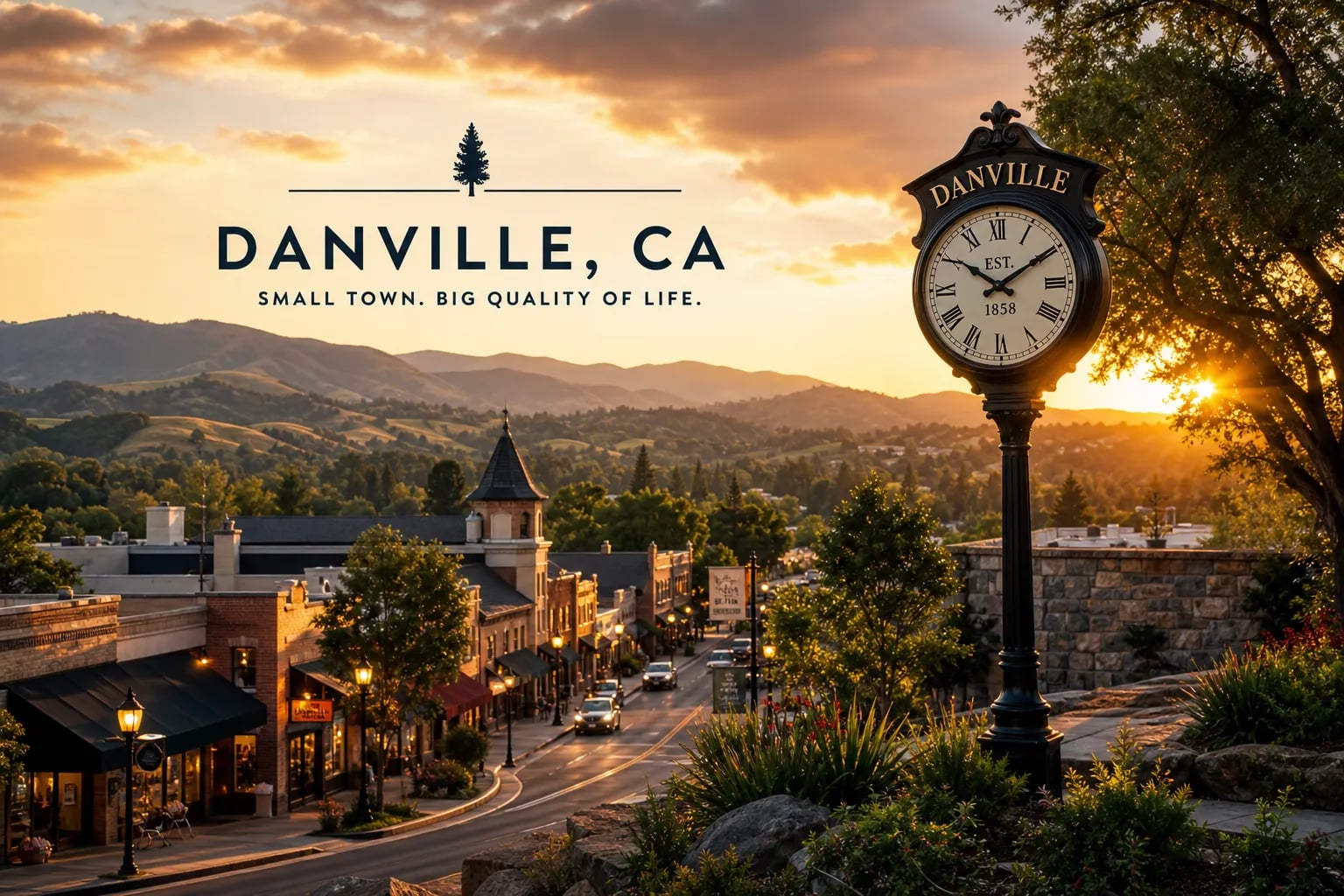
Picture this: it’s Saturday morning, just past 8 a.m. You’re walking along Hartz Avenue with a coffee from Sideboard. The air is still cool. Mount Diablo sits right there at the end of the street like it always does. The farmers market is already pulling people in, dogs are everywhere, and someone you don’t recognize waves at you anyway. That’s Danville on a typical weekend, and it tells you more about this town than any data point can.
If you’ve been asking yourself what is it like to live in Danville, CA, you’re not alone. It’s one of the most searched questions from Bay Area professionals weighing an East Bay relocation in 2026. The short answer is: quieter than most people expect, more expensive than some are ready for, and genuinely excellent on the metrics that matter most to families. This guide covers the real numbers and honest trade-offs, nothing glossed over.
Yasmine Austere, East Bay Relocations Specialist, has been helping families navigate the Danville market and surrounding communities for years. Her monthly Community Corner newsletter and YouTube channel document the neighborhoods, the market shifts, and the on-the-ground lifestyle in a way no listing description ever could. They’re worth bookmarking now and revisiting after you finish reading.
The lifestyle and community culture that define daily life in Danville, CA
What downtown Danville actually looks like on a Saturday
Downtown Danville centers on Hartz Avenue and Railroad Avenue. Among East Bay residents and local guides, it consistently earns a reputation as one of the most walkable and genuinely charming downtown corridors in the region. Boutique shops, wine bars, and locally owned restaurants line the main stretch, and the Saturday farmers market draws a consistent crowd of regulars who’ve been coming for years. This isn’t a manufactured lifestyle district, it feels lived-in in the best possible way.
The town runs a full calendar of community events year-round: the Kiwanis 4th of July Parade (the town’s biggest tradition), the Danville Concours d’Elegance Car Show, a fall Scarecrow Stroll, and the Eugene O’Neill Festival. The social rhythm here is consistent and family-oriented, which is exactly what longtime residents cite when you ask why they’ve never left.
Outdoor access and how residents actually use it
Mount Diablo State Park is the defining outdoor feature of life in Danville. Residents use it frequently, not just for big weekend hikes but for early morning trail runs, cycling loops, and family trips where the terrain keeps everyone engaged. The summit views on a clear winter day cover more of California than almost any other peak in the continental U.S., which is one reason local hiking clubs and cycling groups treat it as a home base rather than an occasional destination.
The Iron Horse Regional Trail is the everyday version of that outdoor access. It’s paved, long, and threaded through the community in a way that makes it genuinely useful rather than just scenic. Dog walkers, cyclists, and joggers fold it into daily routines without much thought. Las Trampas Regional Wilderness and Sycamore Valley Open Space offer backup options when you want something more rugged and less crowded.
The dining scene and social texture
Danville’s restaurant scene outperforms what you’d expect from a town its size. Virtue + Vice consistently draws strong reviews as a local dining destination, and spots like Tides, Revel Kitchen and Bar, Forbes Mill Steakhouse, and Crush’d Wine Bar Kitchen give residents a solid rotation of elevated casual and date-night options. Danville Harvest anchors the farm-to-table end of the spectrum. Most residents find they rarely need to drive elsewhere for a quality meal on a given weekend.
The social fabric here draws a professional, family-forward crowd. Youth sports leagues are well-organized and well-attended. Neighbors tend to know each other by name. New arrivals often describe being surprised by how quickly they felt connected, and that’s not an accident. It’s a product of the town’s walkable core, its manageable scale, and a culture that invests in community programming year after year.
What is it like to live in Danville, CA, schools, safety, and the data behind the reputation
San Ramon Valley Unified and why test scores matter here
San Ramon Valley Unified School District is one of the primary reasons families choose Danville over comparable East Bay cities. The district serves approximately 28,615 students across 37 schools and holds a 5-star rating from SchoolDigger, ranked 97th out of 1,568 California districts. Those aren’t just awards on a webpage, the numbers behind them are substantive.
Math proficiency across Danville schools sits at 69% and reading at 79%, compared to California state averages of approximately 34% and 47% respectively (per SchoolDigger district data). That’s more than double the state average in both subjects. Monte Vista High School carries a 98% four-year graduation rate, and elementary standouts like Creekside (84% math proficiency) and John Baldwin (80% math, 87% reading) consistently rank near the top of California charts. For families prioritizing school quality, Danville’s numbers are genuinely difficult to match anywhere in the East Bay.
How Danville’s crime rate compares to the rest of California
Danville’s violent crime rate is approximately 49.6 per 100,000 residents, compared to a national average of 282.7 (per Niche crime data). That gap is not subtle; it places Danville among the safest cities in California by a significant margin, not just relative to urban centers, but across all city types.
Property crime tells a similar story. Danville comes in well below the Contra Costa County average and well below the U.S. average across burglary, theft, and vehicle theft categories. What this looks like in practice is something longtime residents describe consistently in community forums and local surveys: a neighborhood feel where children have real independence and residents are genuinely comfortable in their surroundings. That’s the texture of safety here, not just a statistic.
What it actually costs to live in Danville in 2026
Home prices and the rental market right now
The median home sale price in Danville sits at approximately $1.8 million as of Q1, Q2 2026, with Zillow reporting $1,814,833 and Redfin confirming the same $1.8M range over the recent three-month period. Average rent runs between $4,079 and $4,600 per month depending on the source and unit type, with Zillow’s modeled average at the lower end and Realtor’s market median snapshot at the higher end.
These numbers reflect the full package Danville delivers: top-tier schools, low crime, strong community infrastructure, and consistent outdoor access. Understanding that trade-off is how buyers make confident decisions rather than sticker-shock decisions. The price isn’t arbitrary, it tracks directly to what the market has repeatedly validated as worth paying.
Property taxes, HOA fees, and what to budget beyond the mortgage
California’s effective property tax rate runs approximately 0.75% to 1.0% of assessed value, and Danville’s median annual property tax bill lands around $7,240. That figure will vary based on your purchase price and any Mello-Roos or special assessments tied to a specific development.
HOA fees vary significantly by neighborhood. Communities like Blackhawk carry structured dues that cover security, maintenance, and community amenities, and those costs need to be factored into your monthly budget before you fall in love with a listing. It’s worth reviewing the specific HOA documents for any subdivision you’re seriously considering, as fee structures vary by section within larger communities. Older, downtown-adjacent neighborhoods typically carry no HOA at all, which can shift your monthly numbers considerably.
How Danville compares to nearby cities
Danville’s cost of living index sits at 238 on AreaVibes, with housing indexed at 513, well above the national baseline of 100. San Ramon and Walnut Creek are the most common comparison points, and both typically offer a slightly lower entry price for comparable square footage and school quality. Buyers who want to stay within San Ramon Valley Unified at a lower price point often start their search in San Ramon, then decide whether Danville’s quieter, more residential character justifies the premium. Yasmine Austere works through exactly this comparison with clients as a standard part of her relocation process.
The real commute: timing, routes, and who Danville works for
Drive times to Oakland, San Francisco, and Silicon Valley
Oakland runs approximately 25 to 26 minutes in light traffic via I-680 north to Highway 24 (verify current routing with Google Maps or Waze, as interchange conditions can affect preferred routes). San Francisco is 36 to 40 minutes by car under normal conditions, but peak-hour bridge traffic routinely pushes that well past an hour on weekday mornings. Silicon Valley destinations along the I-680 south corridor are a different story:
- San Jose: 45 to 55 minutes in morning rush
- Milpitas: 40 to 50 minutes under typical commute conditions
- Santa Clara: 50 to 60 minutes or more during peak hours
Danville’s mean commute time across all residents is approximately 32 to 33 minutes, per Census-derived estimates, a figure that reflects the high concentration of local and corridor-based workers rather than daily SF commuters.
Transit options and the BART reality
There is no BART station in Danville. The standard transit pattern is County Connection Route 21 to Walnut Creek BART, then the Antioch, SFO line into the city. This hybrid commute adds time and requires planning around bus schedules, but it’s a workable routine for remote-hybrid workers commuting two or three days a week.
Danville consistently rewards remote-friendly professionals and those working in the I-680 corridor, biotech, tech, finance, and corporate campuses in San Ramon or Pleasanton, far more than it rewards daily San Francisco commuters. If you’re in the Financial District five days a week, that should factor seriously into your decision. If you’re hybrid or work locally, it barely registers as a consideration.
Danville neighborhoods and which one matches your priorities
Blackhawk: the gated, guard-staffed community experience
Blackhawk is Danville’s most recognized luxury enclave, a gated, 24-hour guarded community built around two championship golf courses and the Blackhawk Country Club’s full amenity program. Homes here trend toward larger estates on generous lots, and the Blackhawk Museum and Blackhawk Plaza add a retail and cultural dimension to the area. It functions as a self-contained lifestyle community.
The HOA-managed environment comes with specific community rules and dues that vary by subdivision. Buyers drawn to a security-first, high-amenity environment will find Blackhawk purpose-built for exactly that. The key is going in with clear eyes about the HOA commitment, this is a community with real governance, not just a logo on a gate. Review the Blackhawk Community Association documents for current fee structures before budgeting.
Downtown-adjacent and older established neighborhoods
Westside Danville and the areas closest to Hartz Avenue offer the most walkability and the most neighborhood character in town. Older ranch-style homes, Craftsman bungalows, tree-lined streets, and proximity to the farmers market and downtown restaurants make these blocks genuinely desirable for buyers who want to be at the center of Danville’s social life. There’s typically no HOA overhead here, which changes the monthly math in a meaningful way.
These neighborhoods attract a mix of longtime locals and newcomers who specifically don’t want a planned-community feel. The trade-off is that homes are older, lots are sometimes smaller, and modern floor plans are rare. For buyers who prioritize walkability and community texture over square footage, this is the most rewarding pocket in Danville.
Newer family-friendly developments and western Danville pockets
Neighborhoods closer to the San Ramon border, including areas along the Tassajara and Camino Tassajara corridors and developments like Alamo Creek and Bettencourt Ranch, offer newer builds, more square footage per dollar, and convenient proximity to Sycamore Valley Road’s retail, services, and schools. These areas attract families with young children who prioritize modern floor plans and easy school access over walkable proximity to downtown.
The Greenbrook and Sycamore neighborhoods split the difference: established, family-friendly, and quieter, with less traffic and wider lots than some of western Danville’s newer builds. Mature tree canopy and a neighborhood-association feel come without the full HOA structure of a gated community. These are the streets that rarely make headlines but consistently hold their value.
So, what is it like to live in Danville, CA? Here’s the honest summary.
Danville delivers exceptional schools, genuine safety, strong community culture, outstanding outdoor access, and a downtown that residents are actually proud of. The price tag is real. At a $1.8 million median and a cost of living index of 238, this is not a discount suburb. The question isn’t whether Danville is a good place to live, it clearly is. The real question is whether it fits your specific life and budget.
A practical decision filter: if you’re a family prioritizing school quality and safety, your budget is above $1.5 million, and you work in the I-680 corridor or remotely, Danville consistently delivers on what it promises. If your daily commute is to San Francisco five days a week and your budget is tight at the $1.5M floor, San Ramon or Walnut Creek may serve you better at a lower price point without giving up the school district entirely.
Yasmine Austere is the natural next step for anyone taking this move seriously. Her Community Corner newsletter gives a monthly inside look at what’s actually happening in Danville, market shifts, neighborhood news, and the kind of local context you won’t find on a listing site. Her YouTube channel walks through neighborhoods and properties at street level, long before you book a flight or a weekend visit. Subscribe to the newsletter, watch a neighborhood tour, or reach out directly to talk through your timeline. This is a big move, and it deserves a conversation with someone who knows every block of it.