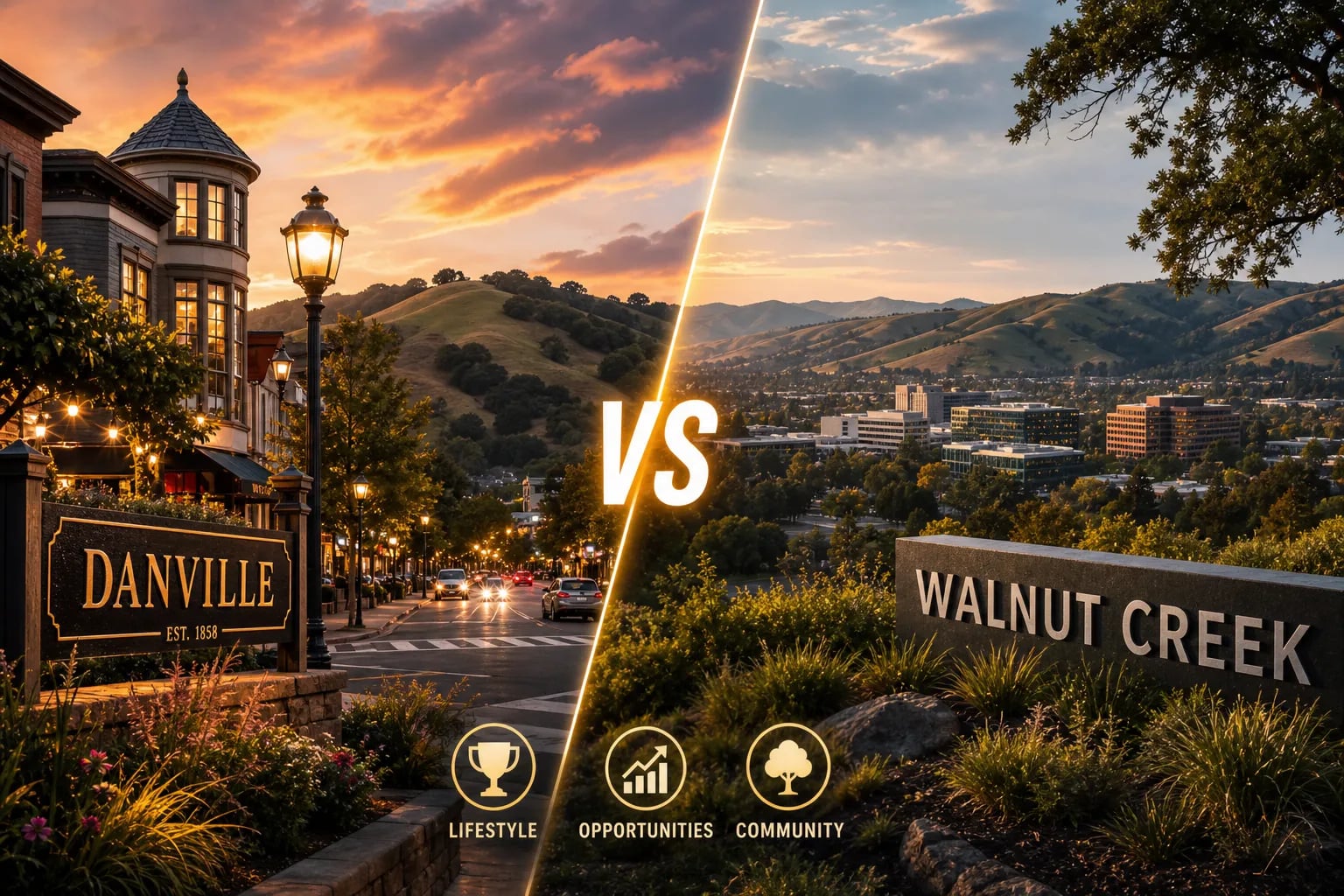
Danville and Walnut Creek sit less than 10 miles apart on the map, but when you compare the two cities side by side, they offer genuinely different versions of East Bay living. The Danville vs. Walnut Creek decision trips up a lot of buyers because both cities look attractive on paper: good schools, safe streets, access to the Bay Area job market, and established neighborhoods with real character. The difference shows up in how you actually live day to day. This guide breaks down both cities across five factors that drive buying decisions, home prices, lifestyle, schools, commute, and safety. By the end, you’ll know which city fits your priorities and what to do next.
One important context note for 2026: both markets have shifted meaningfully from the peak frenzy years. Buyers who sat out 2021 and 2022 now have more options, more time to decide, and more negotiating room than they’ve had in recent memory. That changes the calculus for both cities in ways that matter.
Danville vs. Walnut Creek home prices: what your budget actually buys
Danville’s price range and what comes with it
Danville’s median sale price currently sits between $1.8M and $1.86M depending on the source, with single-family homes typically sitting on lots around 0.24 acres. That translates into real space between neighbors, larger backyards, and the quieter street feel that defines the city. Inventory is up roughly 31.5% year over year per Realtor.com, and prices have softened around 6, 8% per Redfin and Zillow data, which creates genuine negotiating room for prepared buyers. Days on market average 20, 28 days, shorter than the Bay Area single-family average, which surprises most buyers given the price point.
For buyers with budgets above $1.5M, Danville’s current softening is the most significant opportunity the market has offered in years. You’re buying below 2022 peak prices, with more selection and less competition pressure than the city has seen in a long time.
Walnut Creek’s market and value proposition
Walnut Creek prices lower at the citywide median, with a figure closer to $997,000 for all property types combined. That number reflects the full mix: condos, townhomes, and smaller-lot single-family homes alongside traditional suburban properties. Buyers with budgets under $1.5M will find significantly more options in Walnut Creek than in Danville. Homes in Walnut Creek’s most desirable family neighborhoods, Northgate and Walnut Heights, for example, push higher than the citywide median, but entry points exist at multiple levels.
The tradeoff for the lower price point is that you’re getting proximity to downtown amenities and BART rather than the lot size and space you’d get in Danville. For a lot of buyers, that’s not a tradeoff at all: it’s exactly what they want.
How current inventory trends affect your timing
Both markets have tilted toward buyers compared to the peak years. In Danville, inventory is up roughly 31.5% year over year and prices are down approximately 6, 8%, giving prepared buyers meaningful selection and negotiating room. In Walnut Creek, homes are moving in about 18, 36 days depending on the source and price tier. Understanding which market is tightening versus loosening in real time matters as much as knowing the median, which is why working with a local specialist rather than relying solely on online data makes a real difference.
Lifestyle and walkability: downtown energy vs. suburban quiet
Walnut Creek’s walkable downtown core
Walnut Creek earns a Walk Score in the 83, 84 range, which places it firmly in “very walkable” territory for a suburban East Bay city. Broadway Plaza, dozens of restaurants, wine bars, the Lesher Center for the Arts, and a lively Friday-night restaurant and bar scene all sit within easy walking distance of many residential neighborhoods. If leaving the car parked on a weekend matters to you, Walnut Creek makes that realistic in a way few East Bay cities can match.
Neighborhoods like Northgate, Walnut Heights, and Larkey Park attract families specifically because they balance access to the downtown core with quieter residential streets and strong school access. You get the urban energy when you want it without living in the middle of it.
Danville’s village pace and larger lots
Danville’s downtown is charming but deliberately low-key. The Danville Village has boutique shops and restaurants worth exploring, the Iron Horse Regional Trail runs through town and connects to a broader regional network, and the community calendar stays full year-round. But the city is suburban at its core: homes sit on bigger lots, streets are quieter, and the energy is residential rather than urban. If that sounds like a feature rather than a limitation, Danville is almost certainly your city.
The buyers who thrive in Danville tend to want the space, the quiet, and the neighborhood stability that comes with a high-owner-occupancy community. They’re not looking for a walkable bar scene; they’re looking for a backyard, a great school, and a safe street where their kids can ride bikes. Danville consistently delivers on all three.
Matching lifestyle to your actual routines
Buyers who commute into San Francisco and want to decompress in a quiet neighborhood tend to land in Danville. Buyers who want walkability, an active evening social life, and urban proximity without paying San Francisco prices consistently choose Walnut Creek. That split plays out across nearly every buyer conversation, your daily routine is usually the clearest signal of which city actually fits.
School districts: how Danville and Walnut Creek compare
Danville’s top-performing public schools
Danville falls under the San Ramon Valley Unified School District, one of the highest-rated districts in California. Monte Vista High School carries a 10/10 on GreatSchools and an A+ on Niche. San Ramon Valley High School scores 10/10 on GreatSchools and an A on Niche. At the elementary level, schools like Creekside Elementary also carry 10/10 GreatSchools ratings. For families where school quality is the deciding factor above everything else, Danville’s public school lineup is among the strongest in the East Bay, full stop.
Walnut Creek’s school mix and private options
Walnut Creek falls under multiple districts depending on the specific neighborhood, including the Acalanes Union High School District. Las Lomas High School rates 10/10 on GreatSchools and an A on Niche, genuinely excellent by any measure. At the elementary level, Tice Creek, Walnut Acres, Buena Vista, and Parkmead all rank highly and are consistently cited as top choices for families. Foothill Middle School rounds out the strong middle-school options in the city.
Walnut Creek also offers more total schools and a broader range of private school options than Danville, per GreatSchools city-level listings. Families who want strong public schools alongside meaningful private alternatives will find more selection in Walnut Creek. The bottom line: both cities have genuinely excellent schools, but Danville’s top-rated public schools are exceptionally consistent across every grade level.
Commute comparison: Danville vs. Walnut Creek
Walnut Creek’s BART advantage
Walnut Creek has its own BART station, and that is a meaningful edge for anyone commuting to San Francisco or Oakland. The train ride from Walnut Creek BART into downtown San Francisco runs roughly 33, 40 minutes station to station per BART schedules, with full door-to-door commute times typically ranging from 45, 90 minutes depending on first- and last-mile travel and your specific office location. For Oakland, the trip is shorter. Buyers who want to commute by train without driving to a park-and-ride consistently list Walnut Creek’s BART access as the deciding factor in their city choice.
Danville’s commute realities
Danville has no BART station. Commuters typically drive to either Walnut Creek BART to the north or Dublin/Pleasanton BART to the south, adding roughly 15, 25 minutes to the total trip time. A transit option exists via the County Connection Route 21 bus to Walnut Creek BART, but that extends the total commute to San Francisco to around 75, 90 minutes. By car, Danville to San Francisco runs roughly 40, 45 minutes off-peak and 60, 90 minutes during rush hour, consistent with what most East Bay cities see.
Who wins the Danville vs. Walnut Creek commute comparison
If you commute regularly by train or want the flexibility to skip driving on workdays, Walnut Creek is the stronger base. If you drive and your office is in the East Bay or the Tri-Valley, Danville’s commute is manageable and the tradeoff is more home and more lot for your dollar. Remote workers, for whom commute frequency is low, often find Danville’s location a non-issue entirely.
Safety, community character, and long-term fit
Crime rates: a clear difference between the two cities
In recent safety rankings and crime reporting data, Danville’s crime rates rank among the lowest in Contra Costa County and the broader Bay Area. Violent crime runs around 0.58 per 1,000 residents, compared to approximately 2.73 per 1,000 in Walnut Creek per SafeWise data. Property crime tells a similar story: Danville sits near 5.9 per 1,000 while Walnut Creek runs closer to 29 per 1,000. For buyers who weight neighborhood safety heavily, especially families with young children, Danville’s safety numbers are genuinely exceptional and represent one of the clearest separators between the two cities.
Demographics, ownership, and community stability
Danville is a smaller city with a higher owner-occupancy rate than Walnut Creek, a pattern consistent with Census and ACS community profile data. That combination tends to produce stable neighborhoods where long-term residents know each other and community investment runs deep. Walnut Creek has a more mixed profile: higher renter percentages in some areas, more density near the downtown core, and broader demographic diversity across the city. Danville’s profile suits buyers who want neighbors who’ve been there for decades; Walnut Creek suits those who want more social variety and urban density in their day-to-day environment.
Which city fits your life? How to make the call
A quick buyer profile match
Buyers who consistently land in Danville share a few things in common: they’re prioritizing school ratings and safety above all else, they want larger lots and a quieter residential pace, they work remotely or commute infrequently, and they’re buying in the $1.5M+ range where Danville’s softening prices and rising inventory create real opportunity. Buyers who consistently choose Walnut Creek are usually daily commuters who need BART access, buyers with budgets under $1.5M, professionals who want walkability and a social downtown scene, and those who genuinely prefer more urban energy as part of their daily life.
Questions to ask before you commit
Before you schedule tours in either city, run through these honestly: How often do you commute, and by what method? Do school ratings outweigh walkability for your household right now? Are you buying at the top of your budget or leaving room for lifestyle spending? Would you miss a walkable downtown, or do you genuinely prefer a quieter residential street at the end of the day? Your answers will point clearly toward one city or the other in most cases.
Work with someone who knows both cities from the inside
Yasmine Austere has walked buyers through this exact Danville vs. Walnut Creek comparison more times than she can count, and the right answer has been different for nearly every client. As a seasoned East Bay relocation specialist, she knows which Danville neighborhoods offer the best value right now, which Walnut Creek blocks suit which lifestyle, and how to align your specific priorities with the right city and the right property. If you’d like a personalized neighborhood consultation to talk through your situation, reach out to Yasmine directly for a no-pressure conversation.
The bottom line: Danville vs. Walnut Creek in 2026
When weighing Danville vs. Walnut Creek in 2026, the choice comes down to what your daily life actually looks like. Danville gives you space, safety, and elite schools with a quieter suburban pace. Walnut Creek gives you BART access, a walkable downtown, and a more urban daily life at a lower entry price point. Neither city is a compromise; they’re just built for different ways of living.
Use the buyer profile questions above as your filter, then take the next step with someone who knows both markets at street level. The data points in this article will get you oriented; a conversation with a local specialist will get you to the right front door.